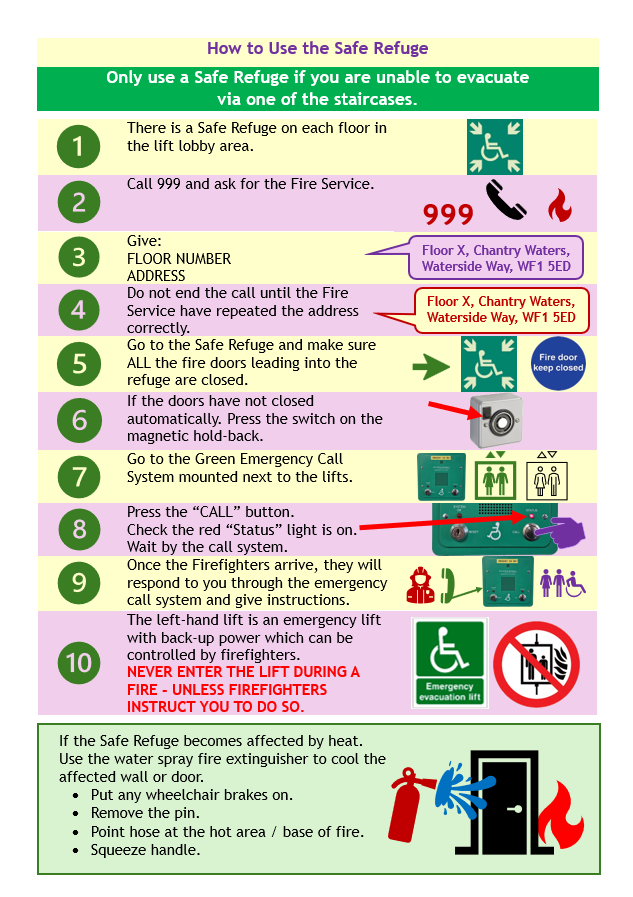
If you need to evacuate the building, and are unable to use the stairs, follow the guide below to use the Safe Refuge. Never use the lift in the event of a fire UNLESS directed to do so by the Fire Service.
If you think it likely that you may need to use this refuge in the event of a fire, please contact the building management so we can work with you to ensure your needs would be met in an emergency situation.
The image below contains a summary of how to use the Safe Refuges. Scroll down below the image for the full text of the procedure.
ADVICE ON EVACUATION OF THE DISABLED AND AGED PERSONS
- Evacuation lifts
During a fire incident, once the Fire and Rescue Service (FRS) is in attendance they will
operate the lift override system to use the lifts themselves to access the fire. As a result, all
lifts in the building to be used by the Fire and Rescue Service will return to the fire service
access level and park. Once this happens, it will not be possible to call the lifts as they will
be under the control of the Fire and Rescue Service.
A suitable evacuation lift is provided, disabled people should make their way to the lift
point and use the communication system to contact the lift operator and make them aware
of which floor they are waiting on. In addition, there is also a refuge call point (adjacent to
the evacuation lift) whereby the disabled person can contact the Fire Rescue Service
Controller in order to tell them which floor they are waiting on.
Fire-fighting lifts may be used in the early stage of the evacuation process in agreement
with the local Fire and Rescue Service.
In buildings where horizontal escape is used prior to exit in an ordinary lift, the instructions
for horizontal escape should be followed first.
- Meet assistance at a refuge.
Some disabled people will require assisted escape. In these cases it will be necessary to
have a pre-arranged meeting place. If the disabled person is likely to move around the
building, a means of communication will be necessary between the escape volunteer and
the disabled person. They can then arrange to meet at a particular refuge point during the
escape.
People should never be left in a refuge point to wait for the Fire and Rescue Service. The
refuge can be used as a safe resting place as well as a place to wait in a phased
evacuation while the go-ahead for a full escape is established. The refuge is equipped with
a suitable means of communication.
Most refuges can accommodate only one wheelchair. This should not be a problem where
there is more than one wheelchair user, provided that there is a suitable evacuation
strategy in place. As one person progresses on their journey, the next person will take
their place in the refuge. Fire compartmentation is also a form of refuge. The refuge may
play a part in the disabled person’s escape journey.
 Chantry Waters Resident's Fire Safety Information